Papers

00. Objects, Artefacts and Us
Tŷ Clai was established by architects Luke Royffe and Emma Flynn as a house, a pottery and an extension of their wider design practice. Our work moves between architecture, landscape, interiors and objects, but begins with the same questions: how materials are put together, how places are inhabited and how things change through use.
The project began with the repair of a neglected building on Fishguard’s high street. Rather than remake the house, we worked with what was already there. Existing walls, uneven surfaces and ordinary materials were retained. New elements were introduced carefully, drawing on our technical understanding of construction, materials and detail. Lime, timber, slate, clay and metal were chosen not only for their appearance, but for how they perform, weather and acquire patina over time.
The pottery developed from this approach. It is not separate from our architectural work, but another way of exploring material, form and use at a different scale. The landscape of Pembrokeshire is a continual reference: its rock, ground, vegetation, weathered buildings and shifting coastal light. These influences are rarely translated literally. They appear through texture, weight, colour, finish and the marks left by making.
We are interested in the point at which an everyday object begins to carry a wider meaning. A bowl may begin as a functional vessel, but it also records the pressure of the hand, the movement of the clay and the behaviour of a glaze. Through use, it gathers further marks and associations. Surfaces change, edges soften and small imperfections become part of the object’s character. Some pieces remain closely tied to function. Others move towards artefact or art object.
Collecting is also central to how we work. The house contains furniture, ceramics, paintings, textiles, books and found objects gathered over many years. We value these things for their beauty, but also as references: examples of form and proportion, material and finish, construction and use. A worn handle, a painted surface, a piece of vernacular furniture or an anonymous vessel can be as instructive as a formally designed object.
Tŷ Clai is not intended as a finished composition. It is a place in which we draw, test, make, repair, arrange and live with things. Through this process, we explore the relationship between people, objects and place, and how meaning is formed through material, making and use.


.jpg)


.jpg)

01. Landscape
Landscape is an important part of how we work at Tŷ Clai, not as an image to reproduce, but as a field of research. We look at the ways land is formed, worked, exposed and changed. Coastal geology sits alongside the remains of industry. Ancient strata meet cut stone, concrete, brick, iron and the marks left by extraction. Each surface contains evidence of the forces that produced it.
The coast of north Pembrokeshire provides a continual point of reference. Around Porthgain, former quarries, brickworks and harbour structures sit within much older geological formations. The distinction between the natural and the made is not always clear. Rock has been cut, displaced and built into walls. Concrete has been washed by the sea until its aggregate is exposed. Iron fixings have expanded, stained and fractured the material around them. Industrial structures have become part of the coast, weathering at the same pace as the cliffs beside them.
We are interested in these different measures of time. Geological formations record pressure, heat and movement over periods that are difficult to comprehend. A rust mark, worn edge or salt deposit may have formed within a few years. Both are records of change. One is not necessarily more valuable than the other. They show how matter responds to force, climate and use.
This attention extends from large formations to small fragments. Strata reveal the direction of movement within rock. Pebbles show the effects of repeated impact and rotation. Sharp material becomes rounded; surfaces are polished, broken and polished again. Colour often comes from the material itself: iron in stone, minerals within clay, organic matter held in the ground, or salt and water acting on a built surface. We look closely at why a rock has taken a particular shape, why one face is smooth and another fractured, and how a material changes when it is cut, fired, soaked or exposed.
These observations enter our work indirectly. They inform the weight of an object, the profile of an edge, the depth of a glaze or the way one material meets another. A ceramic surface may begin with the memory of sea-washed concrete, oxidised metal, wet stone or a quarry face. The aim is not to imitate these things, but to understand the processes behind them and to find an equivalent through clay, pigment, glaze and firing.
Our background in architecture shapes this way of looking. We bring a technical knowledge of materials and construction, but also an interest in failure, repair and adaptation. Erosion may appear destructive, yet it also reveals how something was made. A fractured edge exposes aggregate. Worn paint shows previous colours. A repaired wall records several periods of occupation at once.
Photography, drawing, collecting and making are all part of this research. We document surfaces and gather fragments, not to assemble a fixed visual language, but to build a material reference. The landscape becomes an archive of actions: formation, extraction, construction, weathering, use and decay.
At Tŷ Clai, this archive informs objects, interiors and architectural work. It provides a way of thinking about form and surface, but also about time. The work begins with close observation and develops through testing. What emerges is not a representation of landscape, but something shaped by the same questions of material, pressure, change and duration.


02. Making
Making is a process of doing, stopping and returning. There are periods of concentrated work, followed by long stretches when very little appears to happen. Clay is thrown, rolled, pressed, cut and built by hand, then left to settle and dry. This may take days or several weeks. The pace is partly ours and partly set by the material.
The work often begins through testing and exploration. We make samples, small fragments and groups of related forms. Different clays, oxides, slips and glazes are placed alongside one another. Surfaces are scratched, drawn into, pressed, washed and layered. Some tests begin with a clear idea. Others are simply a way of seeing what a material might do.
Everything passes through our hands. A piece may be thrown on the wheel or built slowly from rolled slabs and coils. It is handled again as it dries, when edges can be changed, surfaces worked and parts joined. The object is then fired, waxed, glazed and fired again. Some pieces are sanded or adjusted afterwards. Between each stage there is time to look and reconsider.
References remain present throughout. A colour may come from iron in a rock face, a surface from sea-washed concrete, or a line from a piece of strata. These things are not copied directly. They sit somewhere behind the work, guiding its weight, texture or form. Sometimes the connection is clear. At other times it has almost disappeared by the time the object is finished.
The process is repetitive. Similar forms are made over and over, each one slightly altered. A wall becomes thinner. A base becomes heavier. A glaze is mixed differently or applied in another layer. The firing temperature may move by only a few degrees. Often the adjustment is so small that it is difficult to describe, but it changes the way the piece feels.
There is also a lot of cleaning. Water runs through the whole process: in the clay, across the wheel, through buckets and over tools and hands. The studio has its own quiet rhythm. The turning wheel, clay being wedged against the table, the scrape of a tool, water being poured away. Work gathers on every surface and is cleared before the next stage begins. This repeated making and cleaning gives the days their shape.
We try not to over-design the objects. The forms are simple and there is room for the material to act. A glaze moves, a line breaks or a surface changes in the kiln. These are not always accidents to be corrected. Sometimes they bring the object closer to what it needs to be.
The work does not set out to look contemporary or historic. Ideally, it feels outside those categories. Something complete in itself, but not overly resolved. A vessel might resemble a fragment, or something shaped by weather and found rather than recently made.
This is the way things go. Making, waiting, firing, looking and beginning again. The work develops slowly through repeated actions, accumulated samples and small changes. Each finished object is part of that continuing process rather than its conclusion.
.jpg)


.jpg)


03. Surface Ground
Surface Ground is a body of work about material, terrain and the marks left by time. The title has a double meaning. It refers to the surface of an object and to the ground beneath us: the place from which material is taken, formed and changed.
The work began with looking. Rock faces, quarry walls, exposed strata, pebbles, rusting iron and concrete washed by the sea. Surfaces where one material has broken away to reveal another beneath it. Some have formed over millions of years. Others are recent: a stain, a fracture, a deposit of salt, the edge of a structure slowly worn down by water.
We photographed, drew and collected fragments. These were not used as patterns to be copied, but as material evidence. A piece of stone might suggest a weight or profile. A line through a cliff might become a cut across a vessel. Iron held within rock could lead to a colour, while the broken surface of concrete might suggest how clay or glaze could be layered and exposed.
The first pieces came through testing. Small slabs, thrown forms, fragments and glaze samples were made in groups and kept around the studio. Clay bodies were mixed and combined. Surfaces were scratched, pressed, cut and washed back. Oxides and slips were applied in layers, sometimes thinly and sometimes with enough depth to crack, run or pull away during firing.
Many of these tests failed. Colours disappeared, surfaces flattened and forms became too deliberate. Other results were difficult to repeat. A small change in thickness, application or temperature could produce something quite different. These variations became part of the work. The aim was not to control the material completely, but to work closely enough with it to recognise when something had happened.
The objects developed slowly from these samples. Some began as vessels, while others were made without a clear use. A rim, opening or foot might suggest function, but the pieces were allowed to move away from it. They became heavier, more closed or less certain in purpose. Some sit between pot, model, fragment and found object.
Surface is central, but it is not treated as decoration. It is part of the form and often records how the piece was made. Layers are built up and removed. Marks remain from hands and tools. Edges are cut, softened or worn back. Glazes pool, separate or expose the clay beneath. The outside of a piece may appear geological, while the inside remains quiet and direct.
The work is shown alongside the material that informed it: photographs, drawings, tests, samples and fragments. These references are not an explanation of the finished objects. They show the path towards them, including the repeated attempts, changes and decisions that usually remain unseen.
Surface Ground marks a shift in our work from primarily functional pottery towards objects with a less fixed role. They can still be held, placed and lived with, but use is no longer the only measure. Each piece is part of an ongoing study of landscape and material: how surfaces form, how they carry time and how an object might feel both recently made and already found.


04. Layers
Tŷ Clai has been made through layers. Some were already there. Others have been added slowly through repair, use and occupation. The house, studio and workshop all carry different periods at once, and much of the work has been about deciding what to keep, what to add and what should remain visible.
An old wall is rarely a single surface. Beneath the latest coat are earlier paints, limewashes, repairs, cracks and changes in texture. Lime render builds depth rather than hiding what lies below. It holds the unevenness of the wall and allows old openings, altered edges and previous work to remain legible. These marks are important. They show that the building has been used, changed and cared for over time.
It is easy to remove this evidence. A wall can be straightened, a door replaced, a surface made uniform. In doing so, much of the life of a place can disappear. At Tŷ Clai, the aim has not been to return the house to one period or to make the new work look old. New elements sit against, within or on top of what was already there. They are not concealed, but neither do they compete with it.
This can be seen in the retained doors, handles and openings. Some no longer work as they once did. A handle may remain even where it is no longer entirely practical. An old doorway may be closed but still visible in the wall. These things are kept because they hold the memory of use. They mark the position of a hand, a route through a room or an earlier arrangement of the building.
Layers also divide and connect inside and outside. Corrugated tin and translucent corrugated sheets form roofs and screens around the workshop and garden. Curtains, linen and lightly obscured glass soften views and control light without closing them off completely. During the day, light passes through these materials in different ways. At night, rooms and workspaces glow through them.
The garden has its own layers. Weeds grow in cracks and at the edges of paths. More considered planting sits alongside what has arrived by itself. Native plants, fruit trees, meadow growth and cultivated areas overlap rather than forming separate zones. The garden is shaped, but never entirely controlled. It remains specific to the ground, the weather and the things already growing there.
Inside, objects add another layer. Ceramics, books, paintings, photographs and collected fragments sit on shelves and in display cabinets. Images of landscape are placed beside materials taken from it. New work sits among older things. The arrangement changes as objects are made, found, moved and used.
Dust, dirt and wear are part of this as well. They gather in corners, settle on surfaces and show where things have been touched or left alone. Patina is not something added afterwards. It develops through cleaning, handling, sunlight, weather and time. A polished edge, a faded fabric or a worn patch of paint records the ordinary life of the place.
Tŷ Clai is not fully restored and is not intended to feel complete. It has been repaired and added to, while retaining the parts that carry its history. The layers remain visible because they tell the story of the building, but also of the people who have lived and worked within it. They allow the place to continue changing without losing what came before.


05. Things
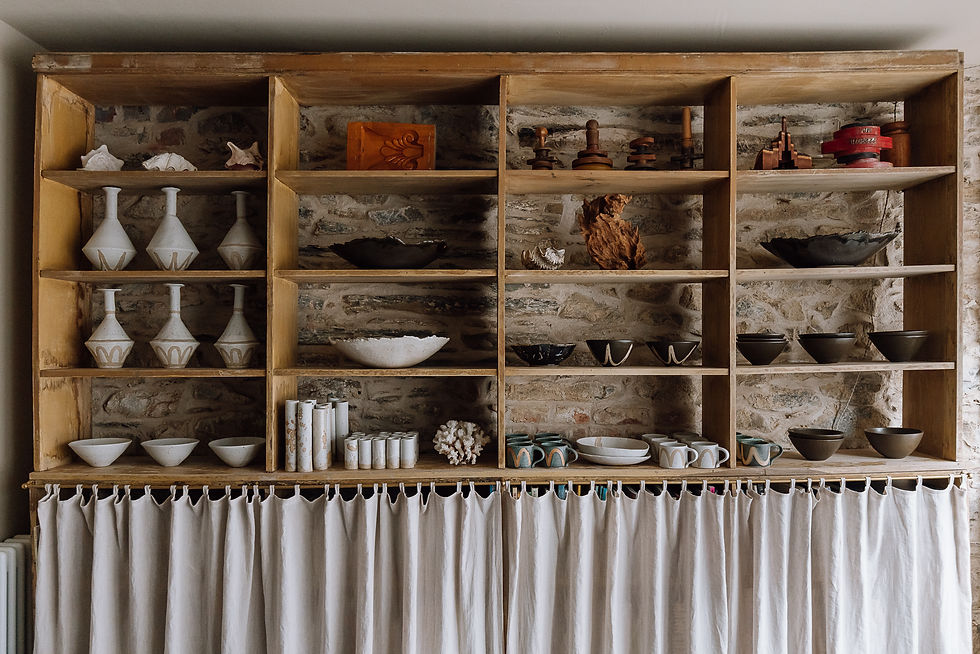
In a pottery, it is difficult to escape things. Tools, moulds, bowls, samples, fragments, materials waiting to be used and objects at different stages of becoming. At Tŷ Clai, we do not try to hide this. We embrace a kind of organised clutter: shelves of order beside shelves of uncertainty, carefully placed objects beside things left where they were last used.
Some things are practical. Ribs, wires, brushes, bats, buckets, glaze sieves and wooden tools. Others have been collected because they are useful as references. Stones, shells, fossils, pieces of coral, pine cones, glass blocks, door handles, old taps and fragments of metal. They are kept for their colour, surface, weight, shape or the way one part meets another.
There are precise things and found things. Manufactured objects with clear edges sit beside pieces shaped by water, weather or time. A brass fitting may be valued for the accuracy of its machining, while a pebble is kept because of the softness of its form. One has been designed and made to perform a task. The other has arrived at its shape through movement and erosion. Both can be looked at closely.
Collections gather slowly. Bowls fill with handles, stones, broken ceramics and small pieces of hardware. Shells sit together because of their colour or structure. Glaze tests form their own groups, arranged by clay, temperature or finish. Paintings, prints and photographs collect on walls and shelves, often alongside the materials or landscapes they recall.
Things are frequently placed inside other things. A vessel holds brushes, tools, fragments or further vessels. A bowl becomes a way of gathering smaller objects that might otherwise be lost. Display cabinets create a loose order, but nothing remains fixed for long. Things are taken out, moved, compared and returned somewhere else.
The studio is full of objects in process. A thrown form dries beside a plaster mould. A fired test sits close to the stone or photograph that informed it. An unfinished piece may begin to influence another before it is complete. Objects are not made in isolation. They sit among other things, absorbing something from their colour, scale, material or position.
Some items are waiting for a future use. An old patinated tap may remain on a shelf until the right project appears. A door handle is kept because it is too good to discard, even when there is no door for it. Samples are stored long after a test has ended because they may become relevant again. Their purpose is not always immediate.
There are also things made simply because we wanted them to exist. Objects with no fixed use, or whose use is secondary to their form. These sit beside domestic bowls, cups and vessels, without a clear boundary between them. A tool can be beautiful. A found fragment can feel designed. A functional object can become something to look at.
The shelves at Tŷ Clai are always changing. Pieces are sold, kept, moved into the house or returned to the workshop. New things arrive and old ones are noticed again. Some collections are deliberate. Others form without anyone deciding that they should.
Tŷ Clai is a place of things: useful, beautiful, unfinished, found and made. Together, they create a working archive. Not a collection arranged to be complete, but one that remains active, open and continually rearranged.


.jpg)